

E. М. Bazelyan, D. Sc. (Eng.), Professor;
recognized Russian Expert in grounding and lightning protection
A main character in a famous foreign movie sourly stated that he would not like to live in the era of dramatic changes. During the previous webinar , we could ascertain that changes in the lightning protection are here with us for the long time, and you can do nothing about it. I received a message from a participant, which was probably motivated by this webinar. The participant does not want any long-term uncertainties and tries to change the situation by his will and particularly with no particular problems or costs. Among others, he asks the following questions on the possibility of implementing particular measures capable of, according to him, quickly arranging the lightning protection design methodology. Here are the most important of them:
- Theoretically, can we, before obtaining the lightning current statistics for a plain using digital sensors, adjust data collected by CIGRE in highlands, with some error?
- Where can we take a method for considering the protection reliability for lightnings with particular currents?
- Can we apply a method for determining the grounding resistance considering the grounding resistance change dynamics within the time range up to 500 μs, which is intended for soils with up to 10 Ohm m, to seawater or river water having resistivities of 1 Ohm m or 50 Ohm m?
- Can an issue of safe touch and step voltages in case of lightning discharges be solved because the new GOST R 12.1.038-2 ELECTRICAL SAFETY approved on May 22, 2024, item 11.4, states: "Limit touch voltage for lightning pulses should be accepted (considering the details of lightning current parameters in GOST R IEC 62305-1) as not more than 6 kV, and limit step voltage not more than 15 kV"?

This request is understandable and, to some extent, justifiable. It is associated with the changes in the attitude toward regulatory documents, and primarily, to GOST, which is only mandatory when the manufacturer declares that the product is made according to a particular GOST. However, there is an exception in terms of the electrical safety. While ensuring this, the manufacturer must follow all regulatory requirements of the respective GOSTs.
In addition to GOST, there are also industrial regulations. It is so easy to get confused, and this fact, to some extent, lets the designer off the leash. Therefore, it is reasonable to analyze the questions asked, the more so they are important for particular tasks in practical lightning protection.
1. Theoretical adjustment of lightning current parameters
Whether it is possible in practical lightning protection, this is a very old question. High-voltage power lines were built in highlands and the answer to this question was very critical. It is also as relevant even today, because usually specialists do not accept conventional lightning current measurements made then at the high-voltage line bottoms using magnetic recorders. The proposal on theoretical adjustment of the CIGRE records oscillographically obtained in highlands seems to be justified. What may the real-life methodology of such assessment look like?
After developing the theory of formation of the lightning current on a plain, we have to obtain the adjustment ratio for highland oscillographic records made by CIGRE and then obtain the lightning current on a plain for a particular probability. If the obtained estimated current matches the directly measured current on the plain, this will prove the eligibility of the re-calculation methodology.
In fact, short contents of this methodological paragraph do not alleviate the entire situation because you have to accumulate all the required statistics of their values to determine the probability of a particular current on the plain. In other words, you will have to perform all measurements we discussed during the webinar. All the rest won't be supported by evidence as any theoretical constructs cannot be proven in any other way.
Surely, it's never too much of a good thing, so you can use a theory of some recognized specialists and add the adjustment ratio with some excess found by them. However, this operation will be rather costly due to the need for arrangement of unjustifiably reliably protection against excessive current. This money will be literally buried into the soil to direct there the lightning current unjustified by excessive calculations.
This is clearly useless. You cannot avoid mass records of lightning currents on the plain for conventional facilities. Direct calculations cannot be replaced with computers.
2. Probability of the strike of a lightning with a particular current to the protected facility
The methodology of such calculations was be developed by specialists of the Krzhizhanovsky ENIN under Contract No. 10-17 with the Department of High Voltage Equipment of the Moscow Energy Institute, which terminated in 2018. Currently, ENIN does not exist any more as a science department. This is why the issue of studying the methodology and software for the calculation of the number of strikes to the facility by the lightning with the current exceeding the specified level may only be resolved through communications with the head of the Department of High-Voltage Equipment of the Moscow Energy Institute.
However, there is also another approach to this task. It is associated with the practicability of applying the new methodology in designing lightning protection. Its solution cannot be currently associated only with the absence of the legal methodology in the existing regulations. In case of a desperate need, the regulatory base may be safely updated by the respective directive authorities.
There is another issue that is problematic. We need to understand technological conditions of the industry for which the lightning protection devices and methods are designed. It is clear that the complicated methodology for calculation of the breakthrough probability for the lightning with the current exceeding dangerous limit values only makes sense when the value already is a known estimated parameter during the design. In another situations, the methodology will be absolutely useless and will not yield any particular clarifying results.
The author of the message under discussion works in the small vessels industry. Resistance of their equipment to the lightning was hardly ever a subject of experimental research. The respective parameters are unlikely provided by vessels' manufacturers in the supporting documents and cannot be probably used in design calculations. In this situation, complication of the design methodology is not justified and recommended for practical use. The designer's rational laziness can be a good reason.
Note that assessment of the resistance of the protected facility to lightnings in most practical situations is a complex experimental problem. To solve it, you need special experimental equipment, which is not usually present in the Russian high-voltage laboratories. It is feasible to start with their creation, with the standardization of the test technique, and with the development of instructions for its mandatory implementation. Only then, the developed methodology for assessment of the probability of the breakthrough of the lightning with a particular current will become more than just a beautiful key to the future and allow arrangement of the lightning protection without excessive parameters compensating for the uncertainty of design estimates.
3. Methodology for calculation of grounding resistance change dynamics
Regulations for the lightning protection do not include a methodology for the calculation of electrical circuit parameters within the theoretical base of electrical engineering based on fundamental laws of electrostatics and electrodynamics. The grounding resistance of the conductor system in the conducting media is such a parameter. Typically, for its calculation, consider the skin effect in the conducting media and sometimes in the conductor, the inductance of a lengthy conductor, and changes in the conductor size due to ionization processes. The description of such processes is subject to well-known fundamental physical laws and does not require special regulatory requirements in the lightning protection documents. Certainly, the calculation methodology must include properly selected parameters of the grounding conductors and their conducting media, thus determining their conductivity, inductance, capacity, skin effect parameters, and, as required, ionization processes in the environment.
Any specialist may develop their own calculation methodology or use the published one, if its results have been proven by experience or where the initial media parameters as mentioned above can be reliably added.
There are reasons to believe that the substance of the question from the message significantly related to the soil resistivity. The experience shows that this parameter is unchanged, although it can vary within a broad range depending on the current density in the soil, its time parameters, and chemical composition of the soil. Special literature provides a lot on this topic. The author hereof does not think he is a specialist in the process responsible for the soil resistivity fluctuations and its effects on the conditions of the lightning current flowing. The only exception is the spark discharge sliding in the air upon direct contact with the conducting media surface. The most important aspect in this gas discharge process is the current leak conductivity through the contact surface. Its chemical composition is not critical. It may be represented by soil, water, or any other conducting liquid.
The sliding spark discharge has been experimentally studied in various soils with different resistivities as well as along the water surface. Its theoretical description yields a different result matching well with the experiment with the pulse current having time parameters of the lightning current. Current amplitudes in separate experiments reached 85 kA. The range of experimentally studied lengths of spark channels exceeded 30 m. There are no doubts in that the developed theory allows reliably describe sliding spark channels also in the seawater having the low resistivity. However, my experimental research shows that any theory created to test applied tasks requires experimental testing. Seawater is not an exception from this.
To summarize this short section, it is useful to remind the following:
All effective calculation techniques for thunderstorm overvoltage in the Russian regulations for the lightning protection only use constant values of the grounding resistance. This process will hardly go any further without legal elaboration of the regulatory base.
4. Electrical safety
The problem itself is associated with that GOST R 12.1.038-2 ELECTRICAL SAFETY approved on May 22, 204, item 11.4, ensures the safety of the touch voltage up to 6 kV, and step voltage up to 15 kV.
Physiological reasoning for the limit voltage values is not given in this GOST. Their relationship with the directions from GOST R 70646.2-2023 (IEC 60479-2.2019) is not discussed, although the latter document contains pulse currents leading to the heart fibrillation that is dangerous for humans.
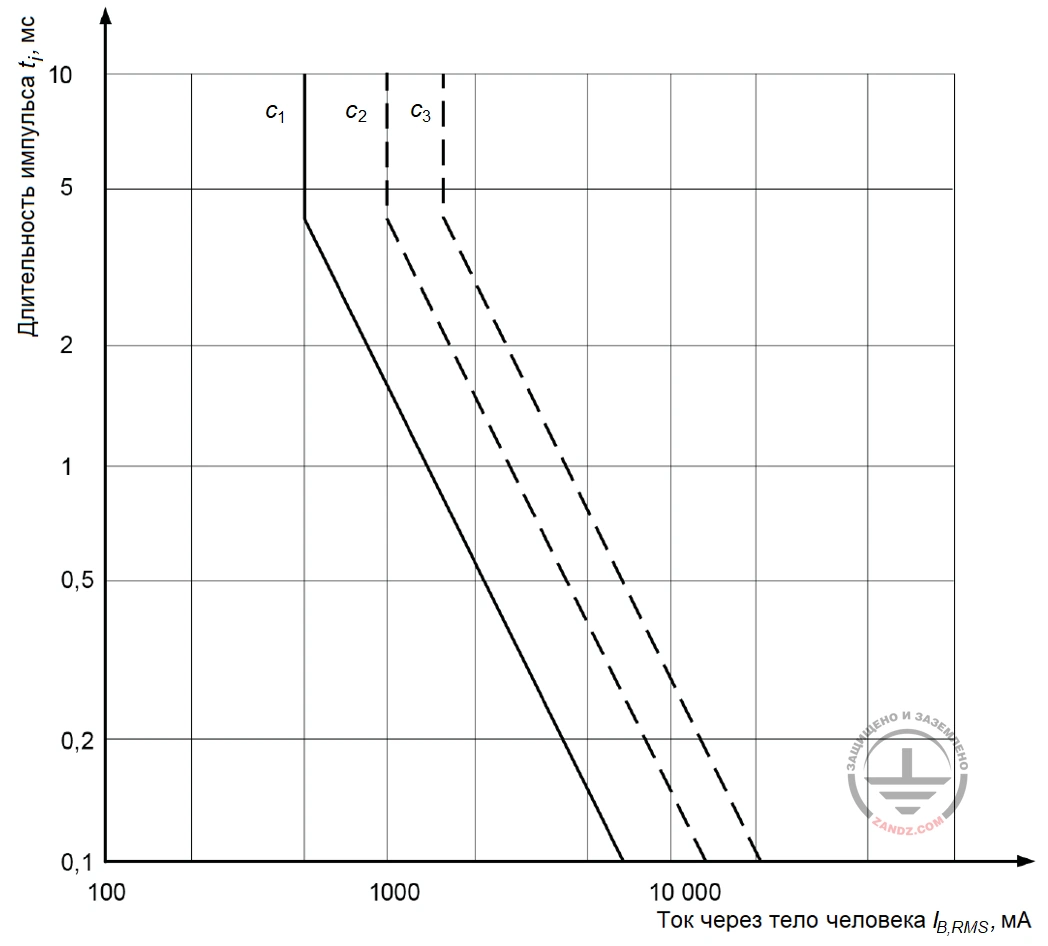
Fig. 1. Current along the hand/foot path vs. time of exposure to excite the heart fibrillation
The solid curve in the diagram shows fibrillation probability of 5%, dashed curves of 50% and more. Dangerous currents are shown in the x axis depending on the time of exposure as shown in the y axis.
When analyzing the situation, note that the data on safe voltage provided in GOST R 12.1.038–2 under discussion are related only to negative lightnings as clearly stated in its Section 11.1. Their re-calculations for the curve shown in Fig. 1 setting fibrillation excitation conditions were made during the GOST development and actually confirmed the safety of the touch voltage up to 6 kV for the current with time parameters of rated currents of negative lightning. However, this does not solve the problem, since reliable oscillographic records indicate the probability of a strike to onground facilities by positive lightnings with pulse currents lasting over 1000 μs instead of 350 μs rated for the negative current. Positive lightnings are not an exotic event. On a plain, they are about 10% of the total amount of storm discharges; the number increases along with the facility's height increase. It is essential to note that the fibrillation threshold significantly reduces along with the increase of the time of exposure to the current. This suggest implementing the control check that must be conducted using real time parameters for positive lightnings.
Related Articles:
"In what cases can lightning ignite a gas mixture?" E. M. Bazelyan
Is Terawatt Laser A Revolution in Lightning Protection? Opinion of Prof. E.M. Bazelyan
 Safe positioning of electrolytic ground terminal: protecting the foundation from the talik zone
 Calculation Example for Lightning Protection and Grounding of a Workshop Located in a Gravelly Soil of 3,000 Ohm*m