

E. M. Bazelyan, Dr. Sc. (Eng.), Professor;
Krzhizhanovsky Energy Institute, Moscow;
recognized Russian Expert in Grounding and Lightning Protection
The issue has been debated for over ten years. It is quite clear that to improve the protective effect of the lightning arrester, it is necessary either to increase the electrical strength of the air along the path of the lightning to the object, or to reduce it on the way to the arrester. Both are physically feasible in theory. The only questions are the cost of such an operation and the efficacy of such technical solutions employed. In the early twentieth century, Marie Curie's laboratory attempted to weaken the electrical strength of long air gaps by using nearly all of the radium available as an ionizing radiation source. There was no noticeable effect. However, this did not prevent European companies from selling a radioactive lightning arrester, which has been marketed as a technological miracle for years. Only in the 20th century, with GOST R 59789-2021, did the Russian State Standard finally dare to acknowledge its complete uselessness through legislation.
And what about the other active lightning arresters? Each year, the number of their types grows. The majority of the proposed designs do not fundamentally contradict the electrodynamic laws. The only issue with their implementation is a trustworthy measurement of the control action's magnitude. This is, for example, the ESE lightning arrester, which uses the effect of accelerating the development of an opposite discharge from a lightning arrester by high voltage generated by a small-sized source.
The situation is incomparably more complicated when the inventor ignores physical patterns, and therefore his imagination is not limited by anything. A typical example is the CTS lightning arrester (also known as the CMCE lightning arrester). This is a grounded rod electrode, the top of which is a spherical capacitor with a grounded lower plate and an open upper one for the external electric field of the atmosphere. The principle of its operation is described by the inventors very briefly. “Each capacitor has one of its electrodes connected to the ground, which is charged with the same polarity as the earth (???). The free (upper) electrode induces atmospheric charges with opposite polarities (???), achieving an internal balance between its electrodes (???), resulting in a potential difference. As a result, a stream of charges enters the earth and is absorbed by the atmosphere (???), preventing lightning formation within their range of action." Despite its briefness, the text is full of glaring contradictions, making it an excellent choice for assessing students' understanding of the general physics course. Let's just say that replacing the capacitor with a regular metal sphere of the same diameter won't significantly alter the external field near the top of the structure. Discussing such inventions is pointless.
It is worth repeating that the fundamental possibility of controlling the lightning discharge is beyond doubt. This is supported by at least many years of experience in the artificial reproduction of so-called trigger lightning, which in a thunderstorm starts at the top of a small-scaled rocket lifting a grounded wire to a height of about 200 metres. Overall, the use of lasers is successful. Lasers can cause the formation of a clearly oriented lightning bolt by heating and ionizing the air in the channel created by their radiation, which then directs the lightning toward a lightning arrester. All we can lament is the expense of laser initiation. To lightning protection specialists, a laser lightning arrester may seem no more exotic than a golden toilet bowl.
The idea that an electric field affects a counterleader is undeniable on its own. It is readily testable through laboratory experiments. The issue is not one of principle but rather of reliably estimating the magnitude and duration of the effective control action of the voltage. No mistakes are acceptable. It is worthwhile to temporarily set aside the process of creating a control action in favor of concentrating on a trustworthy approximation "strictly in grams" of the necessary voltage's magnitude and duration.
In fact, the well-conducting channel of the oncoming leader seems to increase the height of the surface facility. The effect ought to be apparent just for this reason. As a result, the counterleader from the lightning arrester should increase to an amount comparable to the metal lightning receiver height. At the very least, we will discuss sizes in the ten-meter range.
The computer simulation results presented here were obtained at the Krzhizhanovskiy Energy Institute (ENIN) with well-tested software. It allows you to observe the dynamics of the formation of a counterleader from a grounded rod electrode of varying heights in a given thundercloud electric field while accounting for distortion caused by the corona's space charge.
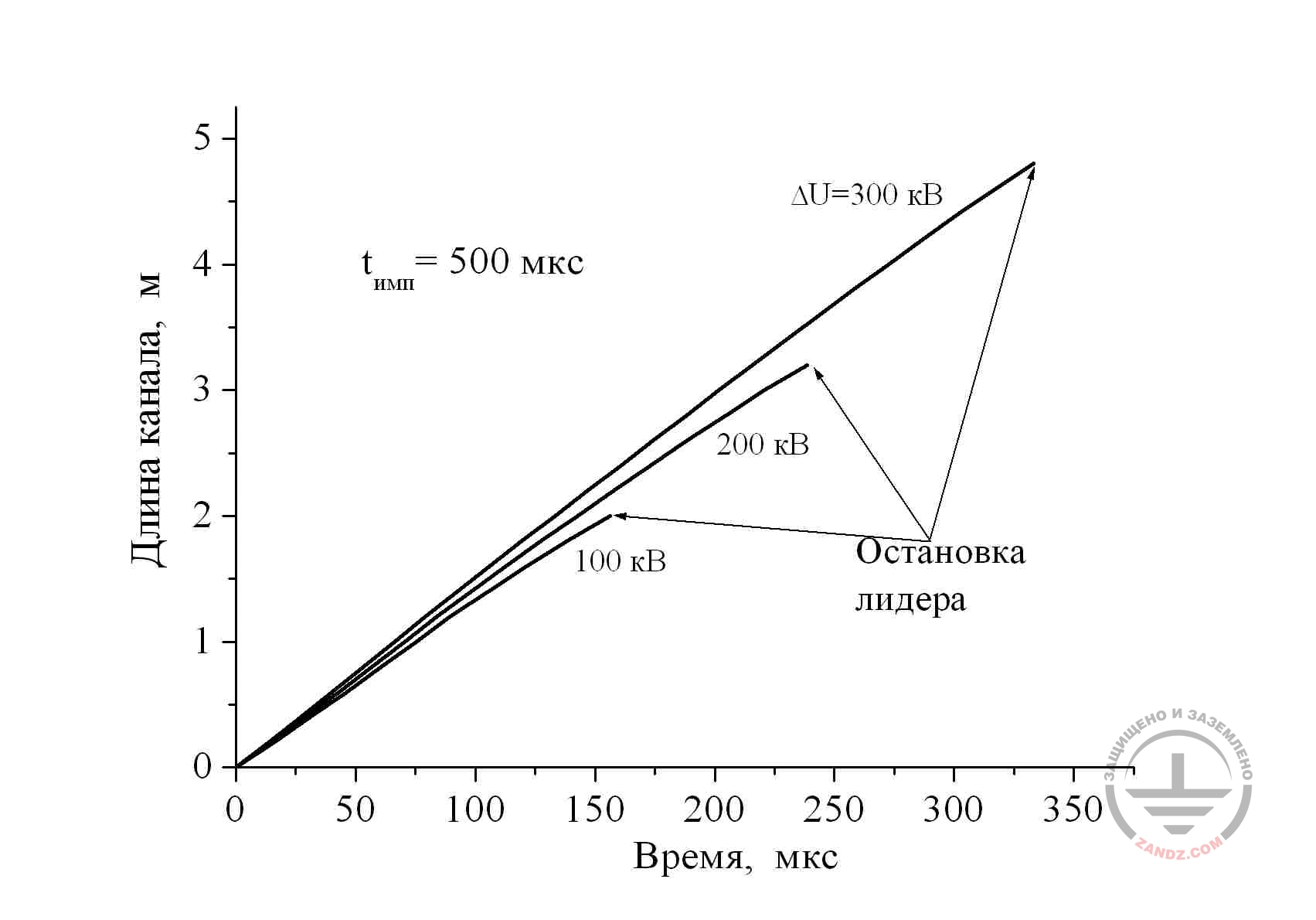
Fig. 1
ЗАЩИЩЕНО И ЗАЗЕМЛЕНО GROUNDED AND PROTECTED
Остановка лидера Leader stop
Время, мкс Time, mcs
Длина канала, м Channel length, m
tимп=500 мкс timp=500 µs
U=300 кВ U=300 kV
200 кВ 200 kV
The data in Fig. 1 characterize the process under very favorable conditions: the height of the lightning arrester is 50 m, the electric field of the atmosphere has increased to 50 kV/m, and the duration of the voltage control pulse is 500 microseconds. Despite this, it is clear that the control action had relatively minor effects. With a pulse amplitude of 100 kV, the oncoming leader stopped its development, advancing only 2 m, and even at U = 300 kV, it stopped short of 5 m, which is a value of little significance for a lightning arrester with a height of 50 m. Even for such a quite long lightning arrester, the amplitude of the control action had to be increased to 500 kV to guarantee the oncoming leader's growth without halting.
To an even greater extent, the result of the control action depends on its duration. This is demonstrated by the computer modeling results shown in Figure 2.
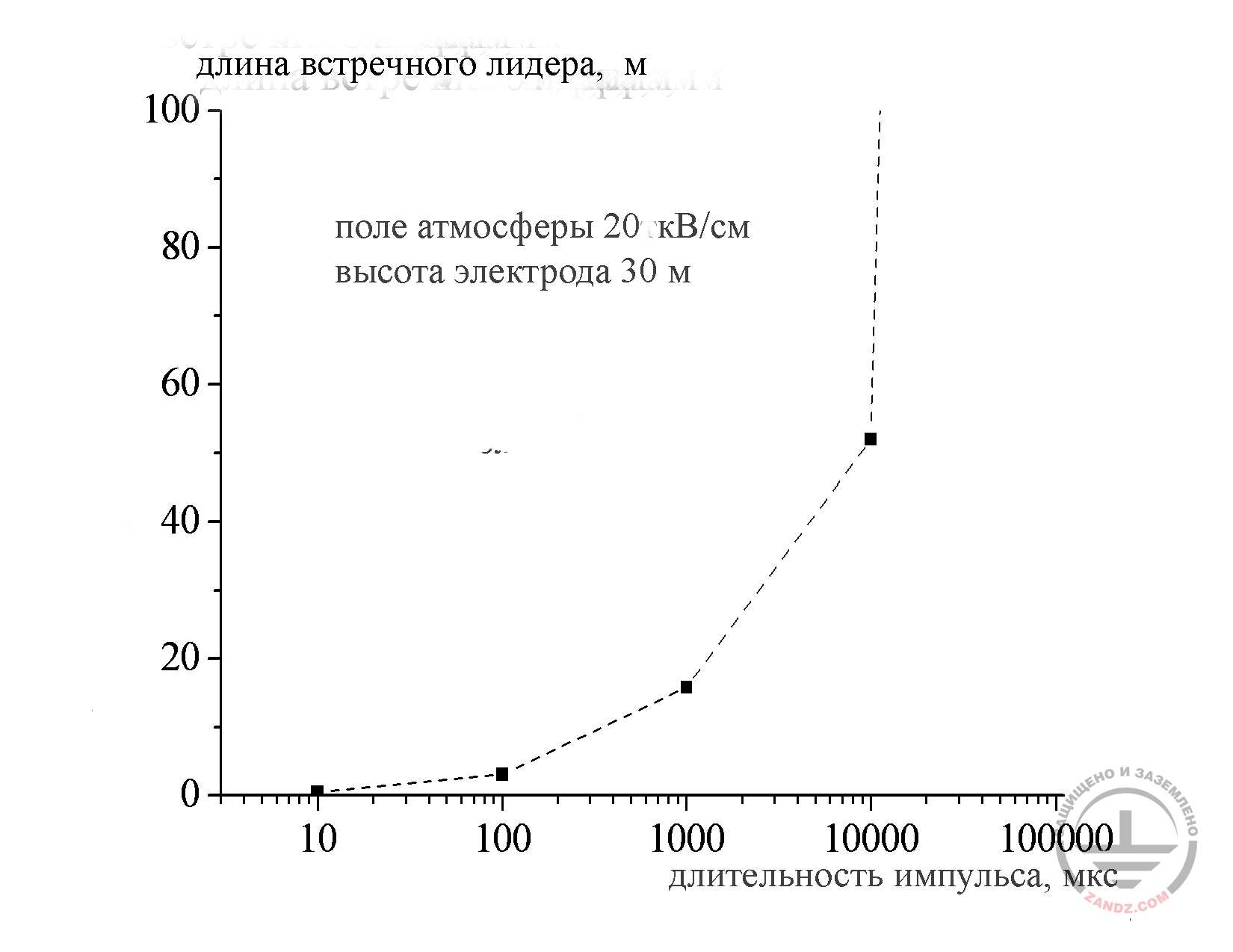
Fig. 2.
ЗАЩИЩЕНО И ЗАЗЕМЛЕНО GROUNDED AND PROTECTED
длина встречного лидера, м Opposed leader length, m
поле атмосферы 20 кВ/см Atmospheric field 20 kV/cm
высота электрода 30 м Electrode height 30 m
длительность импульса, мкс Pulse duration, µs
They were implemented for a lightning arrester with a typical height of 30 meters in a typical thunderstorm electric field of 20 kV/m, but with a voltage control pulse amplitude of 2.5 MV. Even the most dashing inventors of active lightning arresters would not risk swinging at such a powerful control action. The effect of the duration of the control action is extremely serious. The counterpulse's length does not surpass 1 m at a time of less than 10 µs and only doubles at 100 µs.
The outcome is very evident: controlling the lightning strike point, although possible, requires voltage pulses with an amplitude of hundreds of kilovolts with a duration of at least the order of 100 µs.
The generation of a control pulse with such parameters does not cause technical problems. The only issue with such a source is that its overall dimensions are limited. When using ordinary materials available for mass production, we can talk about placing the source in a volume of at least tenths of a cubic meter. This circumstance becomes the primary impediment to the development of an active lightning arrester in modern times. The devices that are currently being marketed on the global market are placed in a volume of no more than a few liters. With such a volume, the source is not able to provide a pulse duration of more than 1-3 µs at an amplitude close to 200 kV, as stated in the brochures of manufacturers.
Operational experience provides the answer to the question of how effective such short-term effects are. It was accumulated not only in laboratory conditions but also through relatively long-term field observations in which the effectiveness of active lightning arresters was compared to traditional ones of the same height. The comparison did not work out, to be honest. Lightning merely ignored the installed active lightning arresters, favoring only conventional ones for a number of years of observations.
To perform the analysis of such amazing results, the computational computer model of the process had to be refined, taking into account the dual nature of the influence of the initial streamer flash, which occurs before the leader's start. To begin, the current of its numerous branches heats up the common base (stem), where, with a certain energy supply, a counterleader arises. Second, the charge of these branches significantly reduces the electric field at the top of the lightning arrester, delaying the progress of the born channel for the time it takes to restore the field due to an additional voltage rise and the drift of the embedded charge to the thundercloud. The shielding effect is significant. The experiment, the results of which are presented in Fig. 3, allows us to evaluate the specific result of short-term stress exposure in conditions similar to those of active lightning arresters. A 3 m high rod electrode with a hemispherical apex with a radius of 1.5 cm was installed on a grounded surface, contacting it through a resistor on which a control voltage pulse with a duration of 3 µs with a steep front was formed. The pulse amplitude reached 300 kV. A negative voltage of up to 1.2 MV with a front duration of ~200 µs on a flat surface raised to a height of 6 m above ground level simulated the electric field of the atmosphere in the discharge gap caused by the charge of the descending lightning leader. An electron-optical converter recorded the optical pattern of the discharge (Fig. 3А) during continuous scanning in synchrony with the oscillograms of the voltage at the gap (Fig. 3Б), the embedded volume charge (Fig. 3В), and the electric field strength at the apex of the rod (Fig. 3Д).
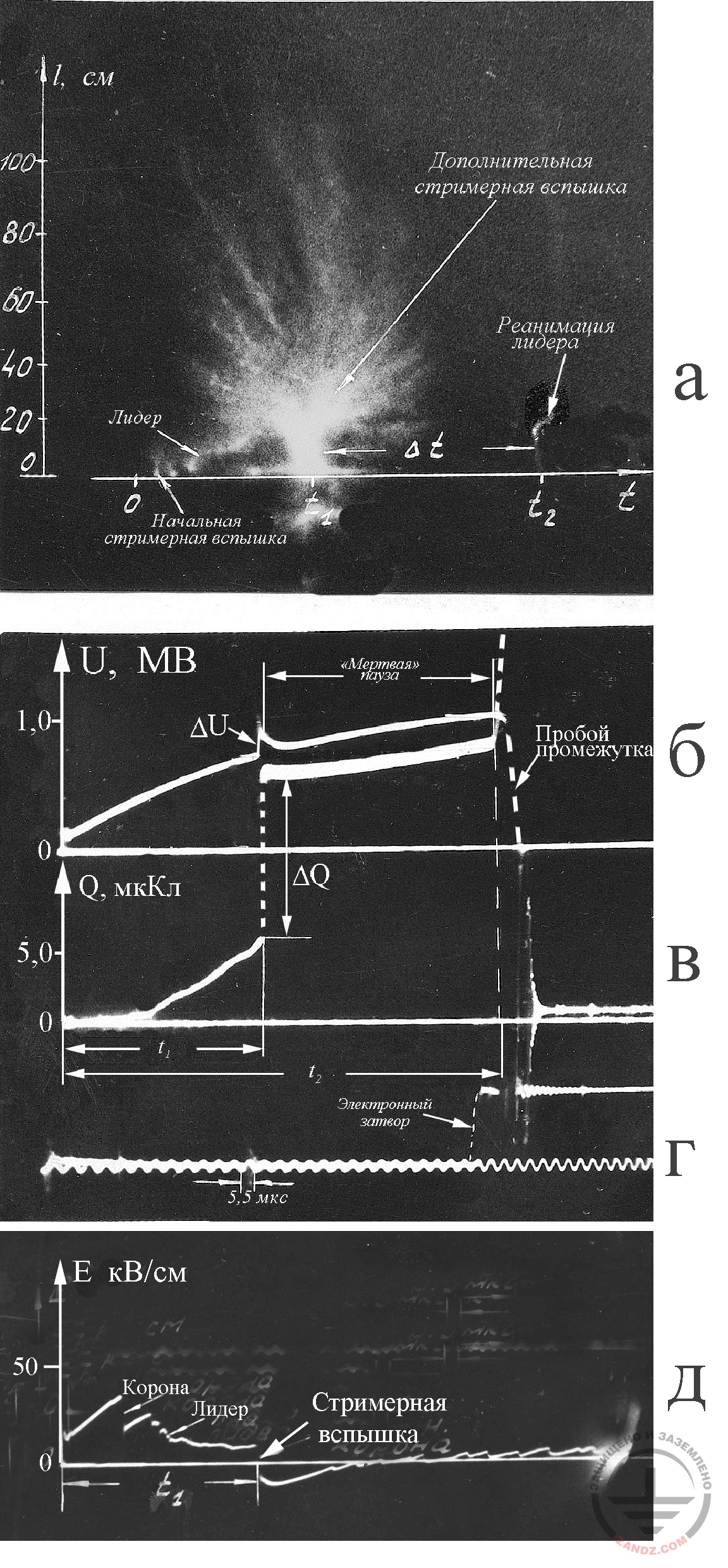
Рис 3.
Дополнительная стримерная вспышка Additional streamer flash
Реанимация лидера Leader reanimation
лидер leader
Начальная стримерная вспышка Initial streamer flash
"Мертвая" пауза "Dead pause"
Пробой промежутка Gap breakthrough
Электронный затвор Electronic gate
Q, мкКл Q, mcC
Корона Crown
Лидер Leader
Стримерная вспышка Streamer flash
кВ/см kV/cm
When exposed to a control pulse, a powerful streamer flash with a charge of the order of 10 mcC was excited, which, shielding the electric field at the tip of the electrode, reduced it down to zero and further up to a change in polarity. Thus, the formation of a counterleader was completely halted for approximately 80 µs. As a result, the electrical strength of the tested air gap not only did not decrease due to the control action but, on the contrary, increased by 20–25%. Taking this into account, the results of testing ESE lightning arresters in field and laboratory conditions become clear, revealing their significantly lower efficiency when compared to conventional rods of the same height—a compelling reason to reject their use in lightning protection practice.
It is critical to note that the analysis was conducted without regard for any design features of active lightning arresters, with the exception of the overall dimensions of the active nozzle that forms the control voltage. Thus, the conclusion about the complete uselessness of modern designs of active lightning arresters with a small-sized nozzle for practical lightning protection becomes universal and needs mandatory regulatory approval.
Related Articles:
 Book: "Questions of practical lightning protection"
 Is Terawatt Laser A Revolution in Lightning Protection? Opinion of Prof. E.M. Bazelyan
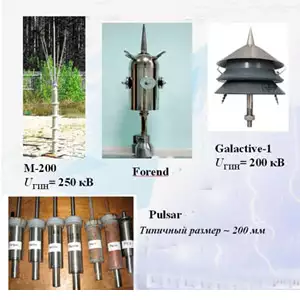 Tests of active lightning protection
 What is the threat when installing active lightning rods?