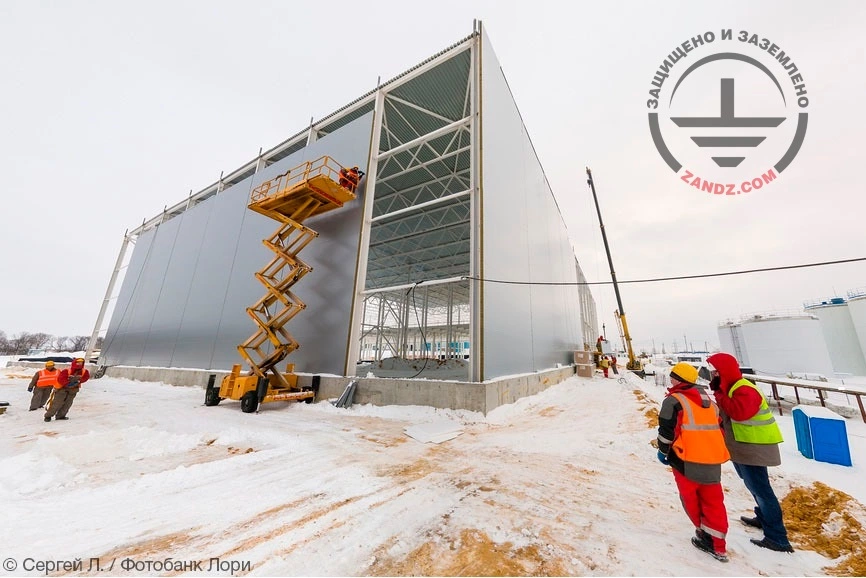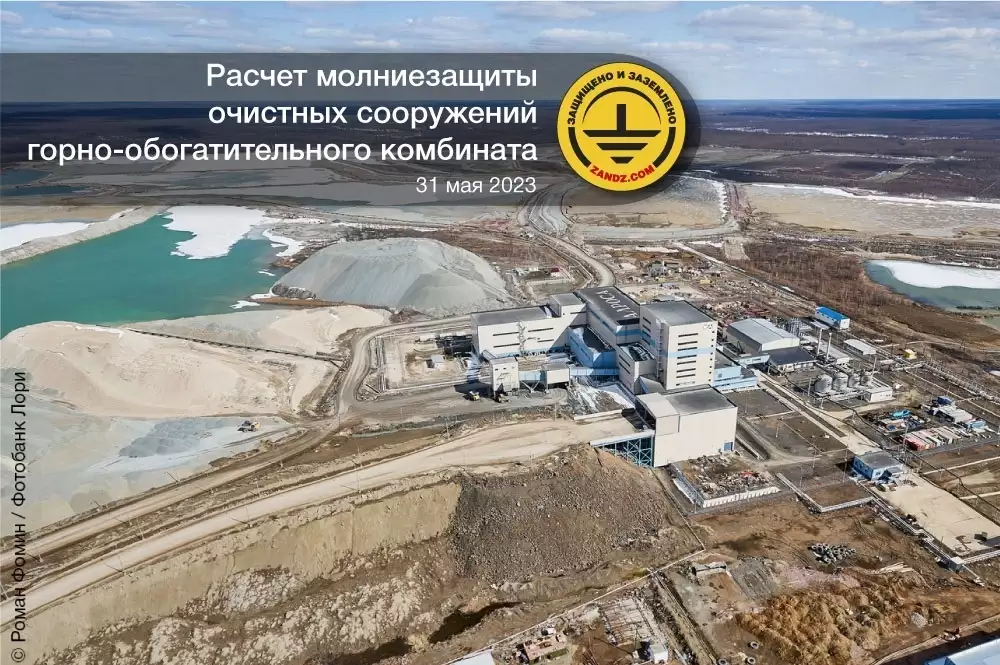

A mining and processing plant (MPP) is a complex facility for the extraction and processing of solid minerals, utilizing sophisticated equipment of various kinds and multiple technological processes and involving a large number of workers and specialized machinery.

The Critical Role of Grounding for a Mining and Processing Plant
We will further examine the specific purposes of a grounding device (GD) and the standards to rely on during design. A GD is necessary for protective grounding and for the external lightning protection system, which are mandatory for industrial enterprises. Sometimes, the earthing circuit is used for potential equalization in large-area buildings (over 100 m wide), in accordance with RD 34.21.122-87, п. 2.26.
Grounding serves to quickly divert short-circuit currents and overvoltages that can lead to damage of expensive equipment and electrical networks. Without proper grounding, such emergency situations can result in equipment failure, significant financial losses, and prolonged downtime.
At MPPs, where work often involves powdered and bulk materials, there is a risk of static electricity accumulation. Proper grounding reduces the risk of electrostatic discharges, which can damage equipment or cause explosions in environments with combustible gases or dust.
Functions, Requirements, and Solutions for GDs at MPPs
MPPs are typically comprised of multiple facilities. Therefore, for organizing lightning protection for the facility as a whole, it is recommended to implement a comprehensive solution and, in accordance with the EIC, clause 1.7.55, install a common grounding device. This offers certain advantages, particularly achieving the lowest possible ground resistance and a common potential across the GD. An exception can be made only for facilities classified as lightning protection Category I; they require a separate grounding device with a resistance not exceeding 10 Ohms, according to GOST R 59789-2021, clause 5.4.1 and Appendix D. Regarding the protective grounding device for MPPs, it can be common for facilities of lightning protection Categories II and III with the lightning protection GD, as per the same EIC, clause 1.7.55.
The resistance of the grounding device can vary for different facilities, but typically it should be no more than 10 Ohms (as this is the requirement for lightning protection GD resistance) and no more than 4 Ohms according to EIC, clause 1.7.101. Furthermore, if high-precision and expensive equipment is used, a functional grounding device with a resistance of 4 Ohms, 2 Ohms, 0.5 Ohms, or lower may be required; this depends on the manufacturer's equipment specifications.
Considering all the above and the fact that MPPs are located near mines and quarries, the question arises: how can low ground resistance be achieved in challenging soil conditions, such as permafrost or rocky terrain? One option could be the use of electrolytic ground electrodes in a horizontal configuration, which can provide up to 12 times lower resistance compared to conventional grounding electrode. These electrodes are installed in a 0.7-m-thick soil layer, minimizing costs for drilling boreholes or breaking up rocky or frozen ground. Another option could be placing the GD remotely in an area with suitable soil, but this approach is limited to a distance of 2 km and is not permissible for functional grounding.
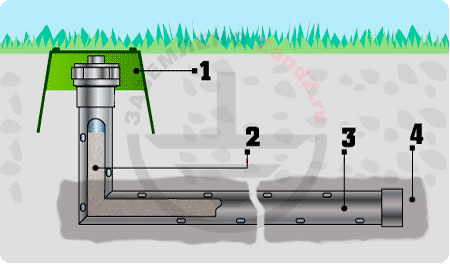
ZANDZ Electrolytic Grounding
Calculation of Grounding and Lightning Protection for an MPP
In conclusion, each facility within an MPP and the entire complex as a whole must be considered individually to determine the required standards for protective and functional grounding resistance. Subsequently, it is necessary to evaluate the facility as a whole and make decisions regarding the design calculation of the external lightning protection system. This system can be unified if using free-standing or catenary wire lightning rods, or it can be individual for each building or structure.
Our ZANDZ Technical Center has years of experience in designing lightning protection and grounding systems for MPPs and is ready to help you arrive at optimal engineering solutions, as well as prepare all necessary calculations, diagrams, and equipment lists.
Related Articles: