

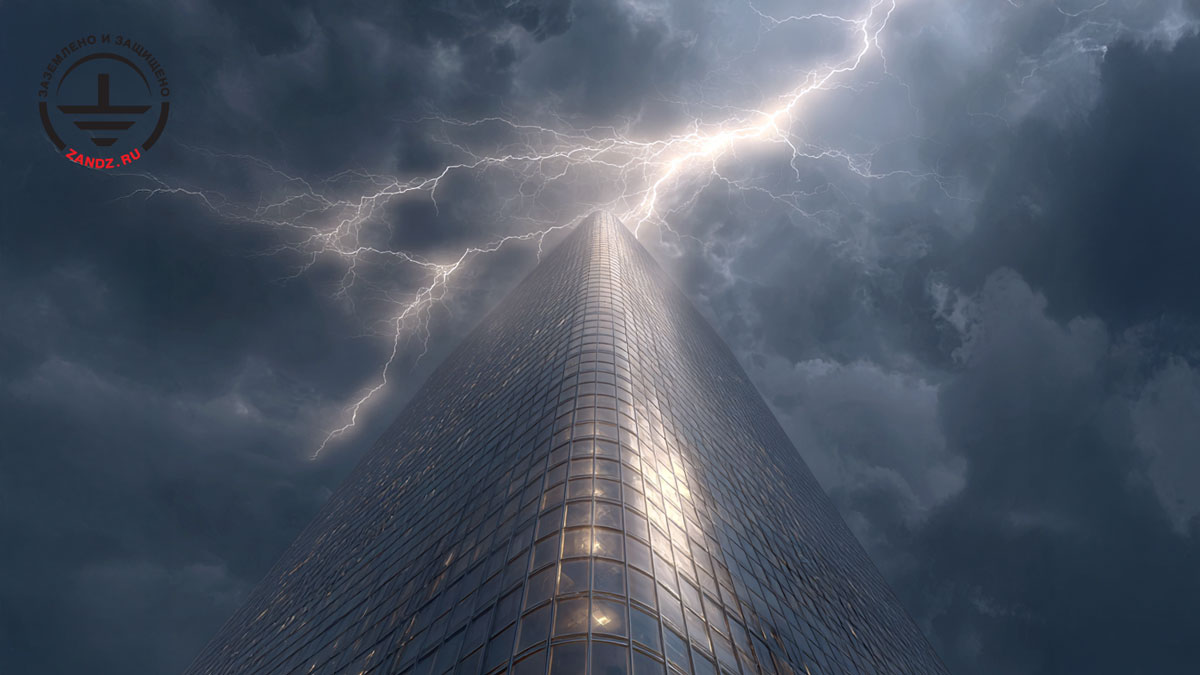
We have published the full version (all parts) of the new article by Professor Eduard Meerovich Bazelyan, "Lightning Protection for Medium-Rise Buildings with Full Wall Glazing."
The article consists of five main topics:
1. Protection of Wall Surfaces: "...The result of this solution is shown in Fig. 1 for a building up to 150 m tall, where upward lightning flashes are not yet initiated. The calculated reliability of protection against direct downward lightning strikes is assumed to be 0.99...."
2. Barrier Effect of Glazing: "...By increasing the thickness of the glass, it is fundamentally possible to achieve its non-penetrability. However, this is unlikely to have any practical significance. Even an ordinary lightning strike with a current of 10 - 30 kA carries a voltage of tens of megavolts relative to ground on its channel, thus requiring completely unrealistic glass sheet thicknesses..."
3. Barrier Effect During Lightning Attachment: "...The glass acts as a dielectric barrier that can prevent the lightning channel from breaking through to a concealed grounded element, especially when an open alternative grounded electrode is present in the system..."
4. Practical Recommendations for Lightning Protection: "...The protective action of the barrier is effective when the width of the lightning's streamer zone is sufficient for simultaneous contact of streamers with both the glass and the metal grounded frame of the glazing unit. This creates the possibility of ensuring effective protection of the glass from damage in glazing units of arbitrary size..."
5. Hazard of Lightning Channel Penetration for Personnel: "...Contact of a weak lightning current with the human body is most dangerous due to the risk of inducing ventricular fibrillation. The experimental dependence in Fig. 10, obtained by IEC experts, demonstrates the relationship between the duration of current flow through the human body and its magnitude under conditions likely to induce fibrillation..."
Read the full article on a separate page.