


E. M. Bazelyan, Dr. Sc. (Eng.), Professor;
Krzhizhanovsky Energy Institute, Moscow;
recognized Russian Expert in Earthing and Lightning Protection
The release of flammable gas into the atmosphere is not a rare phenomenon. It may occur in emergency mode, for example, due to the breakdown of an insulating gasket in a flange connection of a gas pipeline, or it may be caused by a number of technological necessities, for example, to clean up a sudden release of methane in a coal mine face. The explosive mixture of methane and air has to be specially pumped out, transported through the gas exhaust pipe, and released into the atmosphere, creating a fire-hazardous area above the exhaust pipe. Similar areas occur above hydrocarbon fuel tanks when their filled volume increases. The Lightning Protection Instructions RD 34.21.122-87 outline the size of the harmful gas area and the requirement to include it in the lightning arrester protection zone. The latter is quite understandable because the lightning channel with a temperature of 20 000 – 30 000 K, when in contact with a dangerous gas mixture, will certainly ignite it, the consequences of which are not easy to predict in advance. In any case, the experience of operation of gas distribution points (GDS) keeps many stories about their complete destruction by fire.
The practical experience has shown that including an area of a combustible gas combination in the lightning protection zone does not eliminate the risk of its ignition. It probably occurs due to contact with some other sources of high temperature, and exactly high, because for ignition a gas mixture (for example, air-methane) needs a temperature of about 5500С.
In thunderstorm conditions, when a strong electric field is excited near the ground surface, gas-discharge processes near the tops of ground structures, primarily the so-called corona discharge, are traditionally thought to be such sources. It is most commonly seen as a stationary, streamless corona. Its ionization zone covers a very thin area near the top of the structure with a maximally strong electric field. The length of such a zone is often limited to a small fraction of the radius of curvature of the apex, resulting in a microampere electric current. With such a weak current, the gas in the ionized volume remains cold. Due to the constant drift of the gas even in the ionization zone, its temperature does not differ from the ambient temperature even by a few degrees. Clearly, the ignition of the gas emission is out of the question here.
The streamer form of corona discharge presents a completely different situation. Figure 1 shows its static photograph from a metal grounded electrode. The camera captured brightly glowing formations that looked like a tree branch.
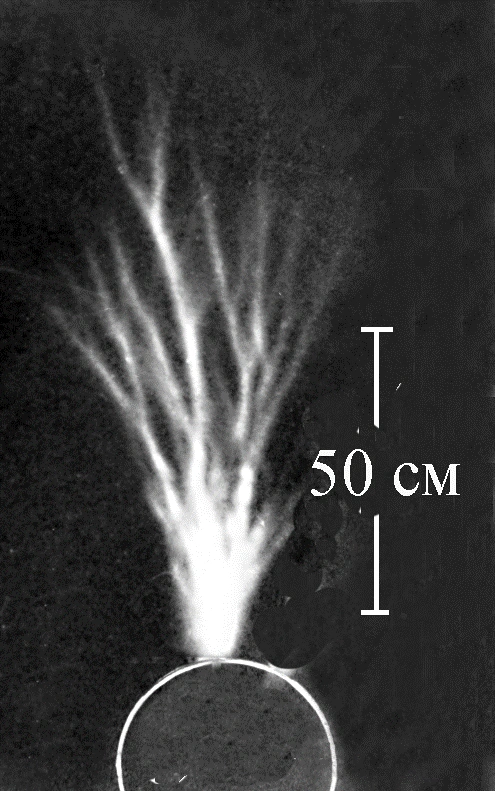
Figure 1: Streamer corona flash
In fact, in a streamer flash, only its common stem, where the currents of all branches departing from it are summed up, is noticeably heated. It is evident that the heating temperature of the stem depends on their number and length. Therefore, not any streamer flash is suitable for igniting a gas discharge, but only a sufficiently powerful one with a length of about 1 m. Its numerous branches together raise the temperature of gas in the stem above 5500 С. In fact, this is enough to give rise to a counter-leader channel in the stem, capable of independent development and further heating. This requires a voltage of at least 400-450 kV in the near-electrode area.
Now is the moment to take me by the hand and lead me to the gas stove, where the gas burner is easily ignited by an electric lighter powered by the 220 V mains voltage. Please do not rush to allegations of quackery. It should not be forgotten that ignition does not require a long source with high temperature. Even a millimeter-long channel is quite suitable for this purpose, as long as it is heated to the required temperature Its minimum temperature has already been set as not less than 5500 С. Celsius. An electric lighter is ideal for this purpose, as it heats the channel with current from the 220 V mains for at least tenths of a second.
The role of such a lighter may well be performed by an earthed human, touching the extended communication at the time of a close lightning strike. Even at a hundred meters from the lightning, electromagnetic induction might cause a spark discharge between the communication and a human. The resulting channel will not be cold. It is easy to perform a quantitative assessment.
In the temperature range up to 10000 , the heat capacity of the air does not exceed
с = 1400 J/(ь3К)
It means that for heating at 5000 of the 1 cubic meter of air, it will require energy W not more than 700000 J or 0.7 J per 1 cm3.
With a good reserve in our very rough estimation we will focus on a spark channel of radius 0.1 cm, which at a length of a few centimeters (say 3 cm) will have a volume ~ 0,1 cm3. Only W = 5000 0.07 J is sufficient to heat it up at 5000. An energy of this magnitude at an interference voltage U of about 20 kV is provided in a communication whose capacity C, satisfying the condition,
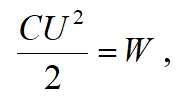
is only 350 pF. With a linear capacity of 10 pF/m, even a 35 m long communication is dangerous if touched. Naturally, the finger of an earthed human has no special significance. Its function may be successfully performed by any grounded, conductive object.
The moral is extremely simple. In thunderstorm conditions, it is reasonable to stop work on any installation with long communications, even underground. This not only protects your life but also considerably minimizes the risk of fire on the installation, which may be extremely expensive.
Related Articles:
Underground utilities are dangerous when struck by lightning! E. M. Bazelyan
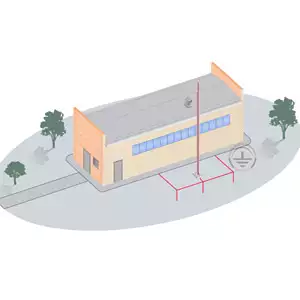 Lightning protection and grounding project of a closed stationary gas-distributing plant
 How To Consider Terrain in Practical Lightning Protection